
What is Freedom?
Freedom. We sing about it in our patriotic songs. We teach it to our children in school. Hollywood and Madison Avenue glorify it. Here in the United States, freedom is the civic religion.
But if freedom is our civic religion, why is the libertarian movement in the U.S. so small? Why is government so big and our jails so full? Is all our talk of freedom mere lip service? Are we a nation of sheeple duped by the powers that be?
Warning: Top Down Thinking Herein
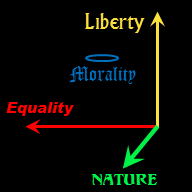
If you are a top down thinker, this is a good place to being your exploration of Holistic Politics. If, on the other hand, you want to cut to the chase, see the red titles if you are interested in equality or dealing with socialists; see the green titles if you are interested in preserving nature or dealing with bureaucratic environmentalists; see the blue titles if you are interested in improving morality or dealing with jail filling moral conservatives.
To some degree, yes. But these are not the major reasons why the libertarian movement is so small. Pure libertarians lack credibility with the masses because they don’t necessarily offer liberty. Abolish the government willy nilly and reduced liberty is the likely result. The power vacuum left by vanished government is likely to be filled by feudal warlords, a military junta and/or invading armies. Anarchy with liberty may be possible but it is not automatic. The People are prudent to refuse the risk.
What about moderate libertarians? What about those who would like to shrink the federal government to its Constitutional bounds? Why haven’t freedom lovers joined their banners en masse? Well, some did, for Ron Paul’s recent run for President, but not nearly enough to win the Republican nomination, much less elect a President. This is supposed to be the Land of the Free. What gives?
It took me years to figure it out, but I believe I have the answer. It is an answer most active libertarians will not like to hear. Pragmatic libertarians do indeed offer liberty, but liberty is not the same thing as freedom!
By “liberty” I mean what my libertarians friends mean by liberty: liberty is the absence of coercion. It is a state of being where transactions are voluntary, where all constraints are the result of honest contracts. I like liberty. I wish we had more of it, here and in other parts of the world. But liberty is not the same thing as freedom. Freedom is something bigger.
So what is freedom?
You can pull out a dictionary for a stilted definition. I will define it simply: freedom is being able to do what you want to do. Free speech and free beer both speak of freedom. Free speech is a freedom that comes directly from liberty. Free beer, however, requires more than mere permission to drink fermented barley. It requires that someone has gone through the trouble to brew the beer and is willing to give it out. If no one is so inclined brew beer and give it away, the ideal of Freedom as in Free Beer contains a conflict. Free beer for you means beer servitude for someone else.
This is why freedom-loving Vulcans stick to promoting liberty. They see the potential conflict inherent in free beer freedoms as a contradiction. Liberty can be granted to all who respect the liberty of others – or at least that’s the ideal. (In practice we run up against a few conflicts – or even contradictions.) So many libertarians would define freedom down to mere liberty, and thus wall off from their minds the messy business of balancing trade-offs.
I say “mere liberty” because for many people more liberty need not translate into more freedom. A marginal increase in liberty can result is subtantially less freedom, especially in the short run. This, I submit, is why libertarianism has limited popularity here in the Land of the Free. For millions of people liberal and conservative ideas offer more increments freedom than many libertarian ideas.
Consider a single mom who has to put in 50 hour weeks at Denny’s to support her children. A cuddly fascist offering government childcare and socialized medicine along with his program of censorship of naughty TV and conquering Bolivia for no good reason offers more freedom to this mother than a smaller government libertarian. This is but one illustration. I give others elsewhere.
Libertarianism has limited popularity for good reason.
This is not a libertarian site. It is a pro-freedom site. Here, we attempt to balance several freedoms, including:
- Freedom from the government.
- Freedom from private criminals.
- Freedom from the boss.
- Freedom from everyone else.
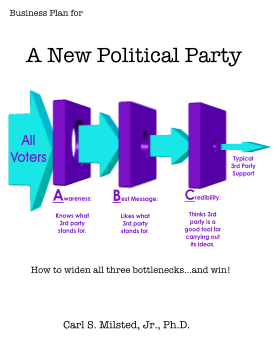
Back when I was a libertarian and active in the Libertarian Party, I spent thousands of dollars and hours promoting the party and the cause. Converts and recruits were few and far between. Today, I am mostly out of the game, playing Candy Land with my young daughter instead of placing signs, dropping leaflets, working booths and attending meetings. Yet I have well over a hundred people lining up to join my nonexistent new political party proposed elsewhere on this site.
Freedom is popular here in the Land of the Free.
What is not popular is knowledge of how to be more free. Many liberals call for mass bureaucracy because they know no other way to achieve freedom from the boss. If that is you, or you wish to persuade such liberals otherwise, see the red titles on the sidebar. Likewise, many environmentalists believe we have to abride economic freedom and/or our prosperous way of life in order to preserve nature. For you I have the green article series. For those of you who desire a safe and moral place to raise your children, there are the blue articles.
If you are ready to dive in and look at specific proposals, feel free to jump to the relevant article series. On the other hand, if you are a top down thinker, or a libertarian/small government conservative who has a hard time grokking the distinction between liberty and freedom, please continue with this series.